
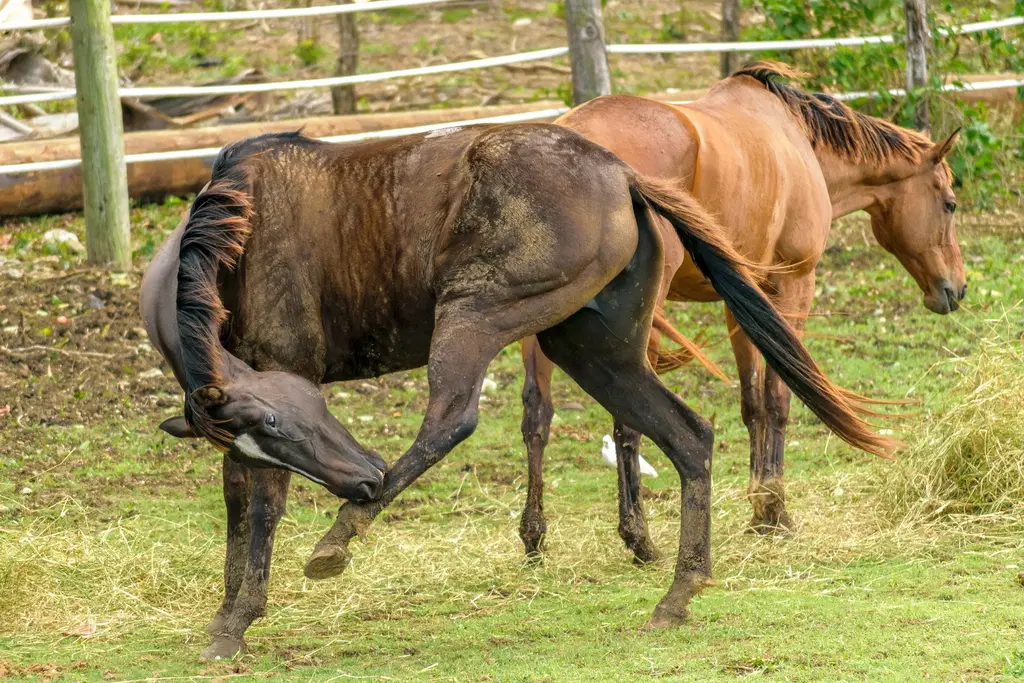
Wound care in horses and when stitches are needed
Horses have an extraordinary talent for injuring themselves on the one sharp edge in an otherwise empty paddock.
Most wounds are minor, but knowing how to assess and manage one in the first hour - and recognising the ones that genuinely need a vet and sutures - makes a real difference to how well it heals.
Assess before you act
Before reaching for anything, take stock of three things:
- where the wound is
- how deep it goes
- whether the horse is sound and behaving normally.
Location matters enormously. A graze over a fleshy part of the hindquarter is a very different proposition to a cut over a joint, tendon sheath or the lower limb, where there’s little soft tissue between skin and vital structures. A small, innocent-looking puncture over a joint can be far more dangerous than a long, dramatic gash across the rump.
Check for lameness, heat and swelling, and note any clear, yellowish or oily fluid. Synovial fluid from a joint or tendon sheath is a genuine emergency and needs a vet immediately, before contamination sets in.
First aid that helps rather than hinders
If there’s significant bleeding, apply firm, direct pressure with a clean dressing. Most bleeding slows within a few minutes; steady pressure beats repeatedly lifting the dressing to look.
To clean a wound, use cooled boiled water or sterile saline. Hose gently if the wound is dirty, but avoid blasting it at high pressure, which can drive debris and bacteria deeper into the tissue.
Resist the temptation to apply powders, creams or coloured antiseptic sprays before the vet has seen anything you think may need stitching. They obscure the wound and some actively interfere with healing.
Strong antiseptics like undiluted iodine or chlorhexidine damage healthy tissue; if you use them at all, dilute heavily.
When stitches are needed
A wound is generally a candidate for suturing when it is:
- Fresh — ideally less than six to eight hours old. Beyond that, bacterial contamination usually makes closure risky, and the vet may opt to manage it as an open wound instead.
- Clean-edged and gaping — where the skin edges won’t sit together on their own.
- Deep — extending through the full thickness of the skin, or involving muscle.
- Over a high-movement or high-value area — such as the face, eyelids or anywhere cosmetic outcome and function matter.
Even when a wound looks suitable for stitching, the vet’s decision depends on contamination, blood supply and tension on the skin. Some wounds are deliberately left to heal as open wounds because suturing them would simply trap infection.
Why lower-limb wounds behave differently
Wounds below the knee and hock are notoriously slow and frustrating to heal. There’s minimal soft-tissue padding, movement constantly disrupts healing, blood supply is comparatively poor, and the area is close to the ground and easily contaminated.
This region is also where horses are prone to proud flesh (exuberant granulation tissue) - an overgrowth of healing tissue that rises above the skin edges and prevents the wound closing over. Lower-limb wounds often warrant veterinary attention earlier than their size alone would suggest.
Tetanus: the risk that’s easy to forget
Horses are exquisitely sensitive to tetanus, and the bacteria responsible thrive in the soil-contaminated puncture wounds that are so common.
Any wound is a prompt to check your horse’s vaccination status. If you’re not certain it’s current, call your vet. An unvaccinated or overdue horse may need tetanus antitoxin as well as starting or boosting its vaccine.
When to call the vet
Beyond joint and tendon involvement, get veterinary advice promptly for:
- wounds that won’t stop bleeding
- anything near the eye
- deep punctures (which seal over and trap infection beneath the surface)
- any wound where you can see structures below the skin
- any injury accompanied by lameness, marked swelling, or a horse that seems unwell.
When in doubt, a phone call costs nothing and often saves a wound that would otherwise have run into trouble.